Showing posts with label Bennette817. Show all posts

Saturday, May 7, 2011

Bennette's Algebra Post

ALGEBRA- a part of mathematics that uses mathematical statements using letters to represent the value of a number.

ONE- STEP ALGEBRA:
eg.

n - 6 = 17
n-6+6 = 17 + 6
n = 23

VERIFY:
n - 6 = 17
23 - 6 = 17
17 = 17

How I got that? Here are the steps:

1.) Isolate the variable.
2.) Cancel using the opposite.
-Create a zero pair for the constant.
3.) Balance on the other side of the equal sign.
4.) Verify your answer.

VARIABLE - the unknown
- use a letter to represent a number

CONSTANT - the integer in an algebraic expression or equation
eg. 3x = 9 <-- equation
3x <-- expression


MULTIPLY and DIVIDE:

1.) Isolate the variable.
2.) Cancel using the opposite
- multiply or divide
3.) Balance.
4.) Verify

MULTIPLY:

3n = 21
/3 /3
n = 7

Verify:
3n = 21
3(7) = 21
21 = 21

DIVIDE:

n/2 = 12
2/2 = 12(2)
n = 24

Verify:
n/2 = 12
24/2 = 12
12 = 12

When there are ( - ), multiply and divide cancel with the same integer.


TWO STEP ALGEBRA:

STEPS:

1.) Isolate the variable.
2.) Cancel the constant.
3.) Balance.
4.) Simplify the variable.
5.) Balance.


VIDEOS:


LINKS:


GAMES:


Monday, March 7, 2011

Bennette's Great Book of Integers

CHAPTER ONE:
GRADE 7 INTEGER REVIEW.

(+4) + (-2) = -2
| ----|-- |
| --and --|____negative 2
| ---------|_____owe 2
|
|___positive 4
|___have 4

STANDARD FORM:
4-2= -2


Make zero pairs:

a) -16 = +16
b) +6 = -6
c) -5 = +5
d) -10 = +10
e) +11 = -11
f) -9 = +9
g) -2 = +2
h) +3 = -3


-6 +2 = -4

-6 -2 = -8

-6 +10 = +4

a) 6- (-4) = +10

b) -3-6 = -9

c) -2-(-3) = +1


SUBTRACTION= adding a negative integer

HOMEWORK:

-6-(-4) = -2
-10+6 = -4
6-7+2 = +11
14-(-3) = +17
* -3-(-7) = +4
* -3-7 = -10
* 3-7 = -4
* 3+7 = +10
* -3+7 = +4

CHAPTER TWO:
MULTIPLYING INTEGERS.


(+2) x (+3) or 2 groups of (+3) = 6
OF normally means multiplying in word problems.

(+2) x (-3) = -6

(-2) x (+3) = -6

(-2) x (-3) = +6

(-3) x (-4) = +12

DO page. 289 Show You Know
and page 290-290 odd numbers only
HOMEWORK BOOK page 90-91

NUMBER LINE:

(+2) x (+3) = 6

(+2) x (-3) = -6

Seatwork:

0(+4) x (+5) = +20 o (+5) x (+4) = +20
1(-2) x (+3) = -6 1(+3) x (-2) = -6
2(-1) x (-6) = +6 2(-4) x ( -5) = +20

(-1) x (-6) x (-1) x (-1)
+6 x (-1) = -6 x (-1) = -6

SIGN RULE (negative signs):

EVEN- when you have an even number of negative factors, the product is positive.

ODD- when you have an odd number of negative factors, the product is negative.

HOMEWORK:
DO page 297 - textbook
page 92-93 - homework book


VIDEOS:


LINKS:


CHAPTER 3:
DIVIDING INTEGERS:
Two Types of Division
6/3 = 2
How many groups of (+3) are in +6?

PARTATIVE DIVISION or Making Parts


6/3 = 2
Share 6 with 3 groups


QUOTATIVE DIVISION or Sharing Your Total with Groups

(-6) / (-3) = 2
How many groups of (-3) are in -6


Only partative will work.

6 / 3 = 2
2 x 3 = 6
3 x 2 = 6

(-6) / (-3) = 2
2 x (-3) = -6
(-3) x (2) = -6

If you have no negative or an even number of negative signs in a division question, the quotient is positive.

-6 / 3 = - 2
Share (-6) with 3 groups


QUOTATIVE DIVISION

-6 / (+3) = (-2)
(-2) x (+3) = -6
(+3) x (-2) = -6


6 / (-3) = -2


When you have an odd number of ( - ) signs in a division question, the quotient is negative.

You'll see something like:


ORDER OF OPERATIONS WITH INTEGERS

When solving integer problems, you need to know or decide what operation to perform.
The order of operations for integers is the same as for whole numbers and decimals.
You should always solve an integer expression or equation by:
1. Brackets. (IF there's a square bracket, do that first then the round bracket)
2. Multiply and divide in order, from left to right.
3. Add and subtract in order, from left to right.

To solve the equation :
(+5) x (-3) + (-6) ÷ (+3),

You have to follow the rules I listed up top. But as you see, the brackets used in that expression was only used as a guide, so you don't have to do something about that. So first, multiply (+5) to (-3) and you'll get (-15). Now, divide (-6) and (+3) and you'll get (-2). Lastly, add (-15) and (-2) and you'll get (-17) as your final answer.

Still having a hard time solving this? Check out this links to help you with the Order of Operations.

http://www.mathgoodies.com/lessons/vol5/intro_integers.html

VIDEOS:


Please correct me if I made any mistakes or tips on how I could make my blog better :)

Wednesday, January 26, 2011

Page 180-181 Questions Number 2,4,6, and 8


QUESTIONS:

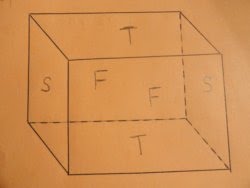
2. A right rectangular prism has six faces. Why might you have to find the area of only three of the faces to be able to find the surface area? Use pictures and words to explain your thinking.

4. Find the surface area of this CD case.


6. Cheese is sometimes packaged in a triangular box. How much cardboard would you need to cover this piece of cheese if you do not include overlapping? Calculate your answer to the nearest tenth of a square centimeter.


8. Paco builds a glass greenhouse.


a) How many glass faces does the greenhouse have?

b) How much glass does Paco need to buy?


ANSWERS
:


2.) I only need to find 3 faces instead of 6 to be able to find the surface area because rectangular prisms share sides. 2 tops, 2 sides, and 2 fronts.


4.) First, you have to find the length and width of each views. For the top view, it's 1cm x 12.3cm, there's 2 top views so it would be 1cm x 12.3 on the other side too. Front view is 14 cm x 12.3 cm, same as the other side. Side view is 14 cm x 1 cm, same as the other side.


6.) A triangular prism has 2 triangles and 3 rectangles.First, we have to find the length and width of the triangles,or rectangles (which ever way you want to start it).We have to use the formula.For rectangle, the formula is b x h =n.The formula for the triangle is b x h divided by 2=n.


8.) Do the steps shown in number 6.
a.) There are 4 glass faces that a greenhouse have.
b.) Paco needs 6.36 m
2.


What is the rectangular prism's formula?


How many faces does a triangular prism have?
or View Results


Here are some videos you may want to check out:


HERE ARE SOME LINKS YOU MAY WANT TO CHECK OUT:

http://www.math.com/tables/geometry/surfareas.htm
http://easycalculation.com/area/learn-rectangular-prism.php
http://www.aaamath.com/geo.html

GAMING SITES:

http://www.shodor.org/interactivate/activities/
http://www.gamequarium.com/math.htm

PLEASE FEEL FREE TO GIVE ANY SUGGESTIONS OR ADVICES.


QUESTION:

(page 266 #8)

150 cm^3 divided by 48cm^2 = 3.125 cm^2
or = 3 cm^2

Simple Sentence: The height of the cylinder to the nearest centimetre is 3 cm^2.


QUESTION:
(page 273 #3)

V = (b x h / 2) x h
V = (1.4 x 1.7 / 2) x 1.18
V = 1.19 x 1.18
V = 1.4042 m^3

1.7 x 4 = 6.8 m <---- Height
1.4 x 4 = 5.6 m <---- Length


a) Yes, he has enough small prisms.

b) 1.4042 m^3 x 16 = 22.4672 m^3 or 22.47 m^3
The volume of the new prism to the nearest hundredths of a metre is 22.47 m^3.

LINKS:
http://www.math.com/tables/geometry/volumes.htm
http://www.online-calculators.co.uk/volumetric/cylindervolume.php
http://www.math10.com/en/geometry/volume.html

QUESTIONS YOU MAY WANT TO SOLVE IN YOUR FREE TIME:
Cube Problems (with the answer at the bottom)
Rectangular Prism Problems (with the answer at the bottom)


What is the formula to find the volume of a Rectangular Prism?

length=3m, width=4m, height=5. What is the volume of this Rectangular Prism?

Sunday, January 16, 2011

Bennette's Final Percent Post

PERCENT - means out of 100
-can be expressed as fraction (n/100) and as a decimal (o.1)

4.1 Representing Percents:
- One completely shaded grid represents 100%
- If you need to shade more than 100, you can use another grid.
- To show a fractional percent between 0% and 1%, shade part of one square
- To represent a fractional percent more than 1%, shade squares from a hundred grid to show the whole number and part of one square from the grid to show the fraction.


EXAMPLE:


4.2 Fractions,Decimals, and Percents
-
Fractions, decimals, and percents can be used to show numbers in different situations.
-Percents can be written as fractions and as decimals.

EXAMPLE:


4.3 Percent of a Number
-
We can use mental math techniques such as halving, doubling, and dividing by 10 to find the percents of some numbers.
- To calculate the percent of a number, write the percent as a decimal and then multiply by the number.


EXAMPLE:
12 1/2 % of 50 = 0.275 x 50
= 13.75


4.4 Combining Percents
-
Percents can be put together by adding to solve problems.
eg. 5% + 7% = 12% ( We always use 12% as tax in our case)
- You can add the combined percent amount to the original number.
eg. 15 % of 100 = 0.15 x 100 = 15
100 + 15 = 115
- You can multiply the original number by a single percent greater than 100.
eg. 155% of 100 = 1.15 x 100
= 115
- Percents of percents can be used to figure out amounts that result from consecutive percent increases or decreases


PERCENT REVIEW VIDEO:


My scribe post: http://spmath81710.blogspot.com/2010/11/pythagoras-textbook-questions-and.html

(I don't have the percent post because I blogged early when our percent chapter started, so I used the last blog I made which is Pythagoras)

Here are some links to help you:

http://www.mathgoodies.com/lessons/vol4/meaning_percent.html
http://www.mathsisfun.com/decimal-fraction-percentage.html
http://www.mathsisfun.com/percentage.html

Here are some math gaming sites you may want to check out:

http://www.mathsisfun.com/games/index.html
http://www.mathplayground.com/games.html
http://www.mathgoodies.com/lessons/vol4/challenge_vol4.html

Here are some percent video you may want to watch:

http://www.youtube.com/watch?v=2rr-IXInEVc